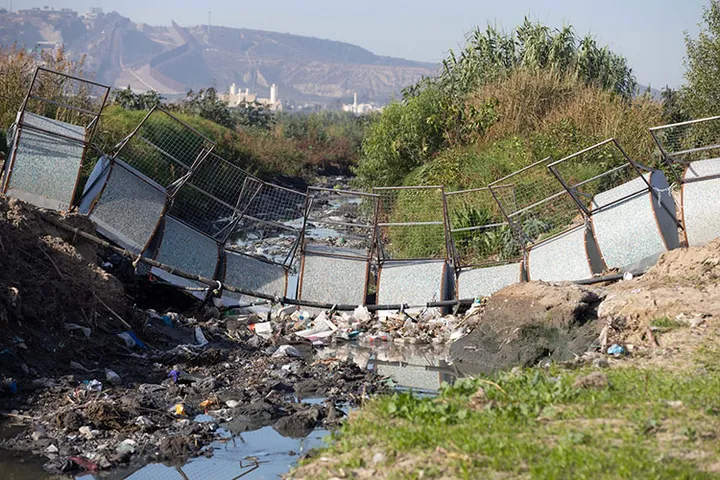
Just north of the border, a floating barrier stretches across the Tijuana River. It's one of the simplest pieces of technology in the fight against the sewage crisis, and one of the few that has held up in this river.
What it is
The trash boom is a horseshoe-shaped chain of floating modules made partly from recycled plastic, anchored across the main river channel. Water passes underneath, and floating trash is held back so crews can remove it. It was designed by Oscar Romo, director of the binational nonprofit Alter Terra, which runs it with the Rural Community Assistance Corporation.
The State Water Board paid $4.7 million to install it in November 2024 as a pilot for two storm seasons. In July 2026, the board approved another $2 million to keep it running through the 2026–27 storm season.
What it has done
- About 2,000 tons of trash and debris stopped over two storm seasons.
- It has held up in big storms. In one February 2026 storm, 80 to 100 tons arrived within hours and piled up about 18 feet high without breaching the boom
- It protects more than the beach. Trash that gets past the border clogs culverts like Saturn Boulevard, fills the estuary, and damages pumps and treatment equipment. Trash also wrecked the ozone treatment pilot in 2025. See Technology trials.
Where it falls short
- It only stops floating debris. It traps tires, mattresses, appliances and plastic, but sewage, dissolved contaminants and sediment pass through.
- It can't be cleared during storms, when trash arrives fastest, because rising water makes it unsafe for crews to work.
- Hauling is the main ongoing cost. Every ton captured has to be removed and taken to a landfill.
- It's still funded year to year as a pilot, not as permanent infrastructure. State contracts run through 2027, but the money is projected to run out at the end of the 2026–27 season. The pilot is meant to inform a permanent design.
Trash capture elsewhere
- Los Laureles Canyon, in Tijuana. WILDCOAST installed the first trash boom in Mexico in January 2021, paired with a program that pays residents per kilogram of plastic collected before it reaches the creek. It added a second boom in Matadero Canyon in October 2024. The canyon drains to the Goat Canyon collector on the U.S. side.
- Smuggler's Gulch. San Diego County maintains a boom and sediment basins where Matadero Canyon crosses the border, and a funded upgrade will add more trash capture.
- Goat Canyon. Sediment basins maintained by California State Parks catch debris before it reaches the estuary.
The bigger lesson
A trash boom treats the symptom. Most of the trash starts in Tijuana's canyons, where more than 1,000 illegal dumpsites and gaps in trash collection send it downhill with every rain. Capture at the border works best combined with cleanup and trash service upstream. Why it keeps happening explains more.
How to help
- Donate to Alter Terra, through Earth Island Institute, or to WILDCOAST's canyon trash boom and paid collectors. Donate to a project has links.
- Join a pre-storm cleanup in the river valley in September and October, when clearing trash from dry banks keeps the next storm from carrying it to the boom and beyond. See Volunteer.
Sources
- State Water Board, trash boom funding extended, July 2026
- RCAC, on what the trash boom cannot catch, February 2026
- San Diego Coastkeeper, Tijuana River sewage
- Earth Island Institute, Alter Terra
- WILDCOAST, Los Laureles trash boom, 2022
- KPBS, WILDCOAST installs a second trash boom, October 2024
- Border Report, rising water levels stop crews removing debris from the trash boom
- IBWC, ozone pilot report, December 2025
- RCAC, Imperial Beach project profile, 2026 — design, hauling costs and the funding runway