Explainer
7 Reasons Tijuana River Valley Pollution Keeps Closing Imperial Beach
The seven documented failures, from Tijuana's unrepaired sewer network to the storm-flow gap no funded project addresses, behind Imperial Beach's sewage closures.
Get monthly updates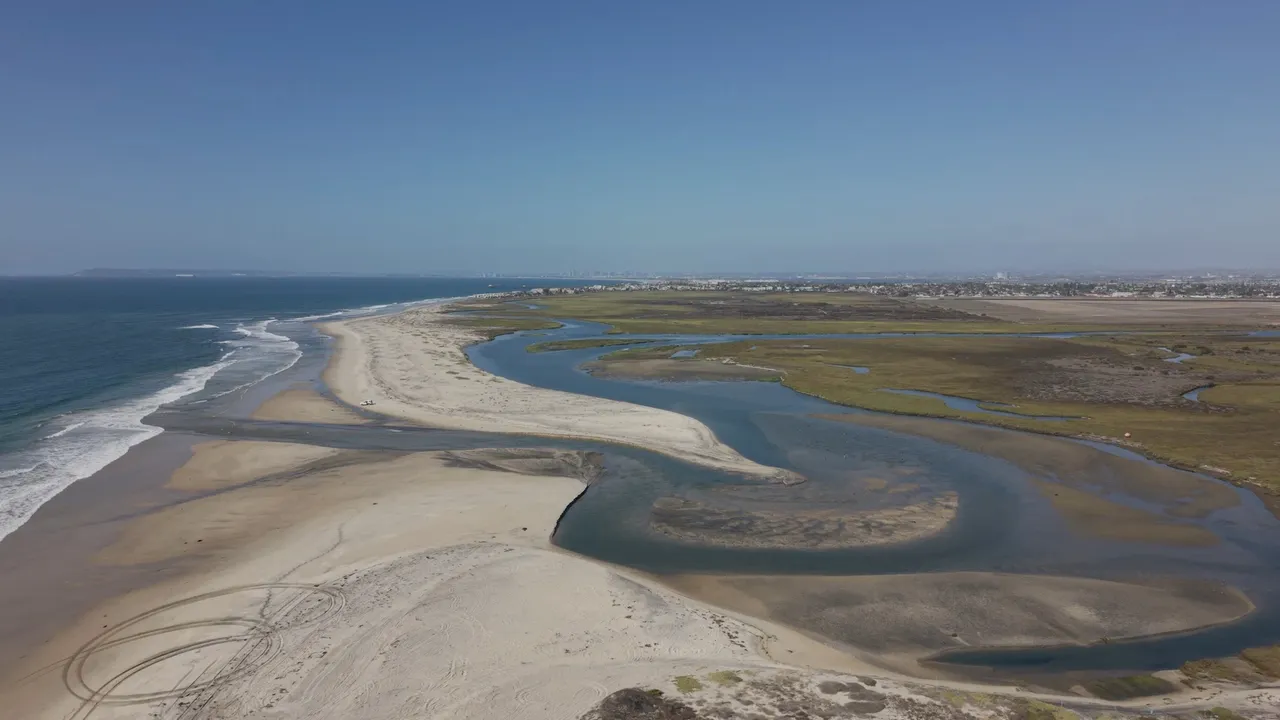
- Tijuana River Valley pollution reaches the ocean by three routes: the river channel itself, the border canyons, and the Punta Bandera shoreline about five miles south of the border.
- The Mexican pump station (PB-CILA) that keeps the river clean in dry weather shuts off above about 23 million gallons a day, which is exactly when storms send the most water.1
- In storms, an average of about 109 million gallons a day of sewage-contaminated water crosses the border untreated (EPA average, 2015 to 2019).1
- In dry months, the biggest single source of water pollution is the San Antonio de los Buenos plant at Punta Bandera, which discharges about half of the water it receives onto the shoreline completely untreated.2
- Most planned or underway fixes address dry-weather flows. Nothing built or funded today is sized for storm flows.
Tijuana River Valley pollution is sewage, trash, and industrial runoff that crosses the U.S.-Mexico border through the Tijuana River, the border canyons, and a coastal outfall south of the border, closing Imperial Beach's shoreline for most of the past several years. Here are the seven primary reasons why:
1. Tijuana's Sewer System Never Caught Up With Tijuana's Growth
The metro area holds more than two million people, and a large share of its growth happened in canyon neighborhoods built without sewer connections or trash pickup. Where pipes do exist, they're failing. A regional report published in March 2026 found that roughly 75% of Tijuana's sewer network and about half its pump stations need urgent repair.3
Sewage escapes before it ever reaches a treatment plant. It leaks into the concrete river channel, runs down Los Laureles and Matadero canyons toward the border, and spills whenever a pump station quits. Mexico committed about $93 million for repairs across 2026 and 2027,45 but unfortunately it only covers a portion of what is needed.
2. The River Pumps Shut Off when they are Needed Most
Just south of the border, a Mexican pump station called PB-CILA pulls sewage-laden water out of the Tijuana River before it crosses into the United States. In dry weather, when it's working, very little sewage makes it across.
The pumps are turned off (and pump no water) when the flow goes above about 23 million gallons a day (MGD), to protect the equipment from sand and trash.1 Most storms blow past that threshold in hours. Ultimately, an average of about 109 MGD of sewage-contaminated water then crosses the border with no treatment at all, based on EPA's 2015 to 2019 average,1 and individual storms have pushed the river past a billion gallons a day in the past.6 The pumps stay off until flows drop back below roughly 23 MGD, which can take days or much longer (PB-CILA was offline from November 15, 2025 until April 2026, and crews cleared sediment before it restarted7) following a storm.
Dry-weather failures can happen as well, creating single events where sewage is released during the dry season. For example, the pipeline carrying diverted sewage to the coast collapsed twice in May 2026, sending tens of millions of gallons into the river.8
3. Punta Bandera Dumps Raw Sewage Right on the Shoreline
The San Antonio de los Buenos plant sits about five miles south of the border on the coast. It receives roughly twice the sewage it can treat on a daily basis. The plant handles about 18 MGD after its 2025 rebuild, and the rest goes onto the shoreline completely untreated, where currents carry it north to Imperial Beach.2
Scripps modeling published by the EPA identifies this entry point as the main driver of dry-season beach closures.9 A binational working group under Minute 333, an agreement signed under the U.S.-Mexico water treaty, is studying an offshore outfall and an expansion to about 43 MGD. Neither is funded.10
You may see a figure of about 50 MGD elsewhere. That's EPA's older number for total flow out of San Antonio de los Buenos Creek, from before the 2025 rebuild.1
4. The U.S. Plant Is Already at Its Limit
The South Bay International Wastewater Treatment Plant, run by the International Boundary and Water Commission (IBWC), the U.S. agency responsible for shared border waterways, treats sewage piped over from Tijuana plus whatever the canyon collectors catch. Its capacity went to 35 MGD in August 2025, and it runs at that limit on a daily basis.11
Volumes and seasons differ sharply by route. This is what reaches the ocean from each one, and which part of the year it drives:
| Source | Dry season | Storm | Treated? | Share of closure pollution |
|---|---|---|---|---|
| Tijuana River mouth | ~1 MGD* | ~109 MGD | No | About two-thirds in rainy season (Scripps) |
| Punta Bandera shoreline | ~18 MGD | ~22 MGD | No | Dominant in dry season; about one-third in storms |
| Border canyons | ~0.5 MGD | ~8 MGD | No, poorly documented | Not quantified |
| South Bay Ocean Outfall | ~35 MGD | ~38 MGD | Yes | Not a major driver |
*~0–1 MGD with PB-CILA fully running; several MGD (up to ~10) during partial operation or outages (IBWC gauge, 2026).612
Figures are approximate averages drawn from public reports as of September 2026. A rebuild to 50 MGD is underway at about $600 million,13 with target dates in public documents ranging from 2027 to 2031. The plant's discharge has been operating under Water Board cease and desist orders since 2021.14 The 2025 order sets conditions for the expansion, which partly bypasses secondary treatment.15
5. Trash Breaks the Equipment Meant to Stop Sewage
More than 1,000 illegal dumpsites sit in Tijuana canyons that drain toward the border.16 Tires, plastics, and construction debris wash downhill in the first storms of the season and clog the sewage treatment and pumping machinery downstream.
Equipment that can't handle trash or sediment includes:
- PB-CILA: Sand and trash are the reason the pumps shut off above 23 MGD in the first place.
- The canyon collectors: Goat Canyon and Smuggler's Gulch intakes have been shut down by sediment and valve failures, sending flows through the valley to the estuary.
- Future treatment plants: Membrane systems proposed for a U.S. river diversion are sensitive to trash and sediment as well.17
The floating trash boom north of the border has stopped about 2,000 tons of debris over two storm seasons.18 Though it has been helpful, it has limitations. It can only catch what floats, and crews can't clear it during storms, when debris is heaviest.19
Hydrogen sulfide readings near Saturn Boulevard have reached 2,100 parts per billion (ppb) as a one-hour average, about 70 times California’s one-hour standard of 30 ppb, during a September 2024 spike. The 1-minute peak was 4,500 ppb (Science, 2025).2021 That's the pollution reaching the air, not just the water, and it's measured at a single hotspot, not across the whole valley.
6. The Infrastructure is Simply Not Built for Storm Flows
Funded storm work is limited to trash and sediment control. Nothing funded for infrastructure improvements is built to treat the much higher volume storm flows.
San Diego County approved $1.8 million for an 18-month first phase to study and develop a U.S.-side diversion and treatment system, on a 4-1 vote.22 Construction depends on Measure B, the half-cent county sales tax on the November 3, 2026 ballot, which is projected to raise an estimated $400 million to $450 million a year, with 22.5% (about $90 million to $100 million) for the river.23 Board chair Terra Lawson-Remer has said that revenue could back $700 million to $1 billion in bonds.17 The San Diego County Taxpayers Association opposes the measure, citing its lack of an end date and of yearly performance targets.24
7. Funding Ongoing Maintenance has Been Especially Difficult
Past fixes on both sides of the border failed because upkeep went unfunded. Pumps get built, then stop being serviced. Rising electricity costs strain the Tijuana utility's budget.25 Minute 333 created a NADBank maintenance account, but it only holds back part of future money sent to Mexico, and its terms aren’t due until December 2026.26
Two more gaps exist that have not yet been addressed by any plan:
- Industrial chemicals: A September 2026 San Diego Coastkeeper report found a steady stream of industrial chemicals, heavy metals, and pesticides in the river. Standard treatment can't remove some of them.27 The Commission for Environmental Cooperation accepted a complaint for review in 2026.28
- Agreements that depend on appropriations: The U.S.-Mexico minutes are conditional on money being available, and the U.S. cannot compel action inside Mexico.29
The trash boom's state contracts run through 2027, but the funding is projected to run out at the end of the 2026 to 2027 storm season.30
Common Questions About Tijuana River Valley Pollution
Why is the Tijuana River so polluted? Tijuana's sewer network has not kept pace with a metro population of more than two million people, and roughly 75% of that network needs urgent repair (regional report, March 2026). Sewage escapes through broken pipes, failed pump stations, and canyon neighborhoods built without sewer connections, then flows down the river channel toward the border. Visit our interactive map to see all the issues in detail.
What contaminants are in the Tijuana River Valley? Public reporting documents raw and partially treated sewage, trash and sediment, and industrial chemicals including heavy metals and pesticides. A September 2026 San Diego Coastkeeper report found a steady stream of industrial contaminants that standard wastewater treatment cannot fully remove. Visit our interactive map to see all the issues in detail.
Is the air safe to breathe near the Tijuana River Valley? Hydrogen sulfide readings near the Saturn Boulevard hotspot have reached about 4,500 parts per billion, far above California's 30 parts per billion standard (Science, 2025). This site doesn't determine what's safe; it links to the county air district's monitors and the AIRE free air purifier program so residents can check current conditions themselves. Learn more about the issues with air pollution.
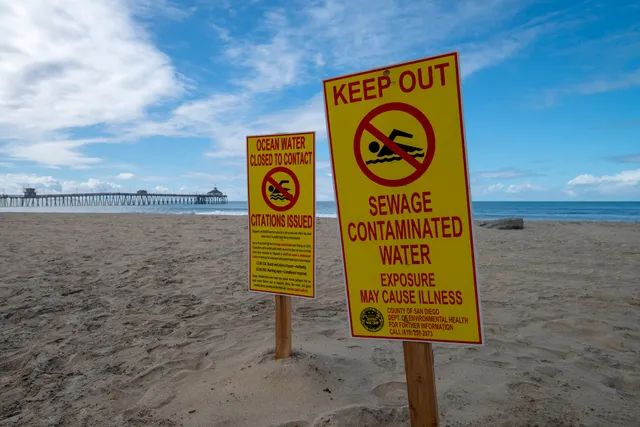
How does Tijuana River pollution affect San Diego beaches? Generally Imperial Beach remains closed consistently. Sewage reaches Imperial Beach through the river mouth during storms, through border canyon collectors when they're overwhelmed, and through the Punta Bandera coastal discharge in dry months. The dominant source of pollution forcing closures changes with the season. Visit our interactive map to see all the issues in detail.
What is being done to fix Tijuana River Valley pollution? Funded projects target dry-weather sewage: a South Bay plant rebuild to 50 MGD, Tijuana pump station repairs, and canyon collector upgrades. No funded project is currently sized to treat storm flows, which can exceed a billion gallons a day. Visit our interactive map to see all the issues in detail.
See the Whole Chain on the Map
Each reason above is one point in a system that runs from a Tijuana canyon to the sand at the end of Seacoast Drive. The interactive map at IB Water Pollution lays out every pipe, pump, and plant on both sides of the border, with dry-season and storm views, so you can trace a closure back to the specific piece of equipment that failed.
Start with tracking where the sewage originates in Tijuana, watch it move through PB-CILA and follow the flow south to Punta Bandera. Then open the project tracker to see which of the 16 projects are funded, which are proposed, and which have no plan at all. If you find something on this page that's out of date or wrong, the corrections channel is there for that.
Sources
- U.S. EPA, USMCA Tijuana River watershed — the PB-CILA shutoff, the storm flow average, and the older 50 MGD Punta Bandera figure
- Coronado Eagle, Mayor's Corner — Punta Bandera treats about half its inflow, August 2026
- CalMatters, March 2026 report on Tijuana's sewer network, for the 75% and half-the-pump-stations figures
- U.S. EPA, Tijuana River watershed: working with Mexico — the July 2025 agreement and the remaining $93 million of Minute 328 funds
- Coronado Times, U.S. and Mexico reach new agreement on Tijuana sewage crisis, July 2025 — construction in 2026 and 2027
- IBWC, summary of the scope of work for Tijuana River diversions, December 2017 — storm flows past a billion gallons a day, and dry-weather flows caught in Mexico most of the time
- IBWC, Mexican IBWC resumes operations at PBCILA pumping station, April 2026
- Underground Infrastructure, pipeline collapse increases wastewater flows in the Tijuana River, June 2026
- U.S. EPA, Beach Impact Comparison Study — the Scripps modeling of beach-closure sources
- U.S. EPA, Minute 333 — the Punta Bandera outfall and expansion studies
- USIBWC, 100-day goal of increasing San Diego plant capacity, August 2025
- IBWC, Tijuana sanitation utility suspends PB1 pump station, April 2026 — river flow with two PBCILA pumps online
- USIBWC, launch of the South Bay plant rehabilitation and expansion, October 2024
- San Diego Regional Water Board, South Bay plant program page — the 2021 cease and desist order, R9-2021-0107
- San Diego Regional Water Board, cease and desist order R9-2025-0139 — conditions for the 35 MGD expansion and the blended flow
- RCAC, partners deploy trash boom, on the canyon dumpsites
- CalMatters, county river diversion plan, September 2026
- State Water Board, trash boom funding extended, July 2026
- Border Report, rising water levels stop crews removing debris from the trash boom
- Science, heavily polluted Tijuana River drives regional air quality crisis, August 2025
- Scripps Institution of Oceanography, Tijuana River's toxic water pollutes the air, August 2025 — the one-hour average and the peak
- KPBS, San Diego County to explore treating Tijuana River sewage flows, September 2026
- KPBS, what to know about Measure B, October 2026 — the revenue estimate and the 22.5% river share
- San Diego County Taxpayers Association, November 2026 positions, August 2026
- U.S. EPA, environmental assessment of the Tijuana River diversion rehabilitation, September 2021 — CESPT's electricity costs (page 8)
- U.S. EPA, announcement of Minute 333, December 2025
- KPBS, report finds the Tijuana River chronically polluted with sewage and chemicals, September 2026
- Commission for Environmental Cooperation, Tijuana wastewater management submission
- Rep. Scott Peters, U.S. and Mexico sign new agreement on Tijuana River sewage
- RCAC, Imperial Beach project profile, on the trash boom's funding, 2026
Spot a mistake? Send a correction