Explainer
Why Imperial Beach Water Quality is so Poor
Explains why Imperial Beach's ocean water stays closed, covering sewage flow volumes in MGD, infrastructure status, and what residents can check or do.
Get monthly updates
- In this instance, "Imperial Beach water quality" means ocean and beach conditions, not tap water. The sewage comes from the Tijuana River crossing the border during storms and from the San Antonio de los Buenos plant at Punta Bandera, about five miles south, which discharges roughly half of what it receives untreated onto the shoreline.56
- The County of San Diego, not this site, decides whether the water is open. Check the county's beach status map before any water contact, and stay out for 72 hours after rain stops.12
- Residents reported health symptoms in a 2024 CDC and county survey: 69% said they had new or worsening symptoms they attributed to the crisis, and 62% reported respiratory symptoms.134
- If you're looking for ways to help you can find: pre-storm trash cleanups in September and October, donations to groups doing verified work, and public comment at agency meetings.
"Water Quality" Means Ocean Water in this Instance
If you searched for Imperial Beach water quality looking for tap water test results, you're in the wrong place. This page covers ocean and beach water, the question most residents have when closure signs go up on the sand. Municipal drinking water here comes from a separate system with its own testing and isn't addressed on this site.
Beach water quality in Imperial Beach follows a distinct set of statuses: open, advisory, warning, or closure, posted by San Diego County based on bacteria testing.3 The water has been closed to swimming for most of the past several years.
The contamination in Imperial Beach's water comes from human sewage, not runoff from lawns, boat fuel, or other common coastal nuisances. Sewage, carrying bacteria, viruses, and, according to research summarized on this site's Health page, hundreds of chemicals including pesticides, solvents, and flame retardants.4
The Two Ways Sewage Reaches Our Beaches
Sewage reaches Imperial Beach water two main ways, and they behave completely differently depending on the season.
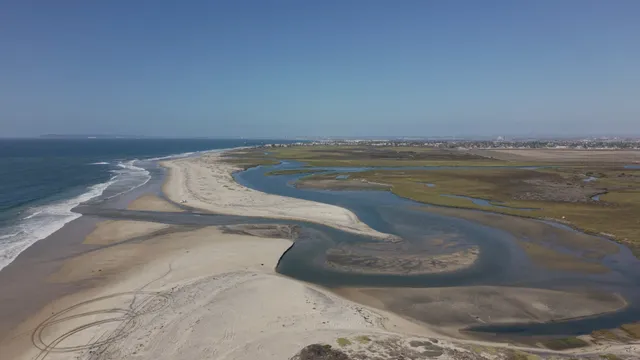
The first route is from the Tijuana River. In dry weather, a Mexican pump station called PB-CILA, just south of the border, pulls sewage-laden water out of the river channel before it crosses. When those pumps work, very little sewage reaches us by river.
The pumps shut off completely (meaning none of the water gets pumped to the treatment plant) when river flow rises above roughly 23 MGD, to protect the equipment from sand and trash.5 In storms, that threshold gets crossed fast. EPA's 2015 to 2019 average puts sewage-contaminated storm flow crossing the border untreated at about 109 MGD during storm flows.5
Route two runs down the coast to the San Antonio de los Buenos treatment plant at Punta Bandera, about five miles south of the border. It receives roughly twice the amount of sewage it can treat. The portion it can't treat, an estimated 18 MGD, is dumped directly onto the shoreline untreated, and ocean currents carry it north, to our waters.6
| Source | Approximate flow | Season it dominates | What stops it |
|---|---|---|---|
| Tijuana River (diverted) | Most dry-weather flow, diverted by PB-CILA | Dry months | PB-CILA pumps, when operating |
| Tijuana River (storm) | ~109 MGD untreated (EPA avg., 2015–2019) | November–April | Nothing currently |
| Punta Bandera / San Antonio de los Buenos | ~18 MGD untreated to shoreline | Year-round, dominant in dry months | Rehab complete (2025); expansion studied, not funded |
| Border canyons | ~0.5 MGD untreated | Storms | Collection systems, partial |
| South Bay Ocean Outfall | ~35 MGD treated | Year-round | Functioning as designed |
Figures are approximate averages drawn from public reports as of September 2026 and compiled on this site's interactive map. Flows vary widely day to day and storm to storm.
Why It Isn't Fixed Yet
The short answer: Tijuana's metro population passed two million, and the sewer system didn't keep pace. Pipes break, pump stations fail, and some homes were never connected at all.7
The longer answer involves money and jurisdiction. Repairs on the Mexican side depend on binational agreements and funding that arrives on its own schedule. Repairs on the U.S. side, including expansion of the South Bay International Wastewater Treatment Plant, depend on federal appropriations. Neither side can fix the other's infrastructure.8 The complexity of solving the problem involves two separate governments and a lot of money.
There is progress though. The San Antonio de los Buenos plant finished its rehabilitation in 2025 and is now running at its original capacity.9 The South Bay plant's first expansion, from 25 to 35 MGD, was completed in August 2025 (EPA, September 2026 update),1018 and a second expansion of the South Bay plant, to 50 MGD, is under construction.11 An expansion of the San Antonio de los Buenos plant to about 43 MGD is being studied but isn't funded.21
These projects take a long time to get going because they have to be planned, proposed, and then wait for funding before they can begin.
What Health Research Says
People in Imperial Beach have reported headaches, nausea, coughing, and throat irritation for years. Since 2024, researchers have started documenting it systematically.
In October 2024, the CDC and San Diego County interviewed residents of 189 households near the Tijuana River Valley.12 80% said the crisis was hurting their quality of life, and 69% reported new or worsening symptoms they attributed to it.13 Of those surveyed, 62% reported respiratory symptoms.4
A San Diego State University survey drew more than 500 participants from Imperial Beach, Nestor, San Ysidro, and as far north as Coronado and National City.14 In a peer-reviewed analysis published in August 2026, 74% of participants reported upper respiratory symptoms, and about half reported nausea or bloating.15
Surveys record what people report. They don't prove what caused each symptom. A UC San Diego exposure study and a county retrospective study using hospital and cancer registry records are both designed to get closer to that question. The first is underway and the second is still being planned.16 We don't have their answers yet.
Exposure isn't limited to getting in the water. Research led by Scripps Institution of Oceanography found that bacteria and chemicals from sewage-polluted water become airborne in sea spray and were detected in the air in Imperial Beach.17 That's part of why air quality and water quality get discussed together.
Get the 411 on the Water Status Before Swimming
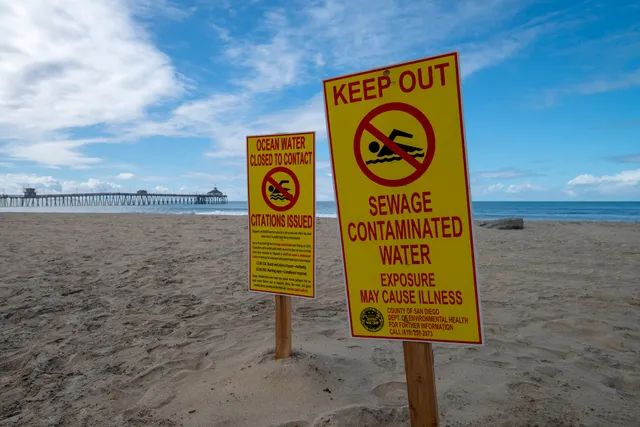
The County posts four status levels, and the words on the beach signs match the words on the county map, with one exception. Rain advisories are issued countywide but are not posted on the sand at all.32
- Closure: Sewage-contaminated water is present. Stay out entirely, including surfing, swimming, and wading.
- Warning: The water may be affected by sewage, and contact may make you sick.
- Advisory: Bacteria levels are above state health standards.
- Rain advisory: Issued countywide after about a fifth of an inch of rain. Avoid all ocean and bay water for 72 hours after the rain stops.2
Testing takes time, so the posted status can lag conditions. Brown or murky water near the river mouth, thick foam along the shoreline, a rotten-egg smell, or fresh trash lines on the sand after a storm are all reasons to stay out regardless of what the sign says.
Every Little Thing Helps
No single person is going to fix a binational sewer system, but that doesn't mean you can't be a part of the solution.
Trash is one area that everyone can help solve, no matter how big or small the act. Debris washing down in the first storms of the season jams the pumps meant to catch sewage and the booms meant to catch trash downstream.5 September and October are the window for cleanups that protect that equipment before the rainy season starts.
| Action | Time required | When it matters most | Where to start |
|---|---|---|---|
| Pre-storm trash cleanup | Half a day | September–October | Take Action hub |
| Sign up for hydrogen sulfide alerts | Minutes | Year-round | County air district, text or email |
| Donate to a vetted group | Minutes | Year-round | Take Action hub |
| Public comment at agency meetings | 1–2 hours | When projects await funding | Project tracker |
This site lists groups including WILDCOAST, Alter Terra, San Diego Coastkeeper, Surfrider, and the Tijuana Estuary Foundation, with links to their own sites so you can read what they do and judge whether the work is something you believe in before giving anything.
Public comment is the lever that's easiest to skip, but is still highly important. Several projects on the tracker are designed, permitted, and waiting on appropriations. Appropriations respond to pressure from people who show up on the record.
Common Questions About Imperial Beach Water Quality
These five come up more than any others, with links to the pages behind each answer.
Is Imperial Beach open right now? The sand is open, but the water has been closed to swimming for most of the past several years because of sewage from the Tijuana River and Punta Bandera. Check the county's beach status map for the current reading before going in.
Can you swim at Imperial Beach? Not while the county has the water closed. Closures mean sewage-contaminated water is known to be present, and contact can cause stomach illness, rashes, and ear, eye, and skin infections.3
Why is Imperial Beach water quality so bad? Two sources drive it: Tijuana River flow that crosses the border untreated during storms, averaging about 109 MGD (EPA, 2015 to 2019), and the San Antonio de los Buenos plant at Punta Bandera, which discharges an estimated 18 MGD of untreated sewage onto the shoreline year-round.56 Visit our interactive map to see all the issues in detail.
Is Imperial Beach water quality improving? Some infrastructure has moved forward. The San Antonio de los Buenos plant finished its rehabilitation in 2025, and the South Bay plant's first expansion, from 25 to 35 MGD, was completed in August 2025 (EPA, September 2026 update).91018 The South Bay plant's expansion to 50 MGD is under construction,11 an expansion at San Antonio de los Buenos is still being studied,21 and closures have remained frequent through 2026.1920 This site tracks status project by project instead of reporting one overall trend, since progress varies widely across the roughly 16 major efforts underway. Visit our interactive map to see all the issues in detail.
Is it safe to walk on Imperial Beach sand even when the water is closed? Generally yes. Closures apply to the water, not dry sand. Stay out of the water, the wet sand at the waterline, and the river mouth, and follow any posted signs.
What This Site Can and Can't Tell You
IB Water Pollution doesn't decide whether the water is safe. It shows the official readings, explains what they mean, and links you to the agencies that set the standards. The County is the authority on closures, and nothing here is medical advice.
Start with Is It Safe Today? for current beach water, air quality, river flow, and recent rainfall, all pulled from county, air district, IBWC, and National Weather Service sources. If you want to do something rather than just know something, the Take Action hub lists volunteer opportunities, donation options, and meeting logistics with dates attached. If you find something on this site that's wrong or out of date, the corrections channel is there for exactly that.
Sources
- San Diego County beach water quality — the current status of every beach
- San Diego County, beach and bay public summary, on rain advisories — about a fifth of an inch, countywide, 72 hours
- San Diego County, beach and bay status levels and advisory types
- San Diego State University, Health impacts in residents exposed to Tijuana River pollution, white paper, July 2025 — chemicals found in the water, and the 62% respiratory figure
- U.S. EPA, USMCA Tijuana River watershed — the PB-CILA shutoff and the storm flow average
- Coronado Eagle, Mayor's Corner — Punta Bandera treats about half its inflow, August 2026
- CalMatters, March 2026 report on Tijuana's sewer network and pump stations
- Rep. Scott Peters, U.S. and Mexico sign new agreement on Tijuana River sewage — agreements conditional on funding
- USIBWC, letter to stakeholders on the April 4, 2025 tour of the San Antonio de los Buenos plant, April 2025
- USIBWC, 100-day goal of increasing San Diego plant capacity, August 2025 — the 25 to 35 MGD expansion
- USIBWC, launch of the South Bay plant rehabilitation and expansion, October 2024
- San Diego County, CASPER community health assessment — survey dates and the 189 households
- San Diego County CAHAN advisory, September 2025 — 80% quality of life, 69% new or worsening symptoms
- KPBS, New survey reveals more details about Tijuana River sewage crisis, July 2026 — the SDSU survey's participants
- BMC Public Health, health symptoms and environmental perceptions from the Healthy Water Healthy Air Study, August 2026
- San Diego County, Tijuana River Valley and beach water sewage crisis studies — the UC San Diego exposure study and the retrospective study
- Environmental Science & Technology, bacterial and chemical evidence of coastal water pollution in sea spray aerosol, 2023
- U.S. EPA, Tijuana River watershed public updates — the September 2026 quarterly update
- Times of San Diego, Imperial Beach coastline closed over sewage contamination, September 2026
- KPBS, county reopens two Imperial Beach areas, September 2026
- U.S. EPA, Minute No. 333 — the Punta Bandera outfall and expansion studies
Spot a mistake? Send a correction